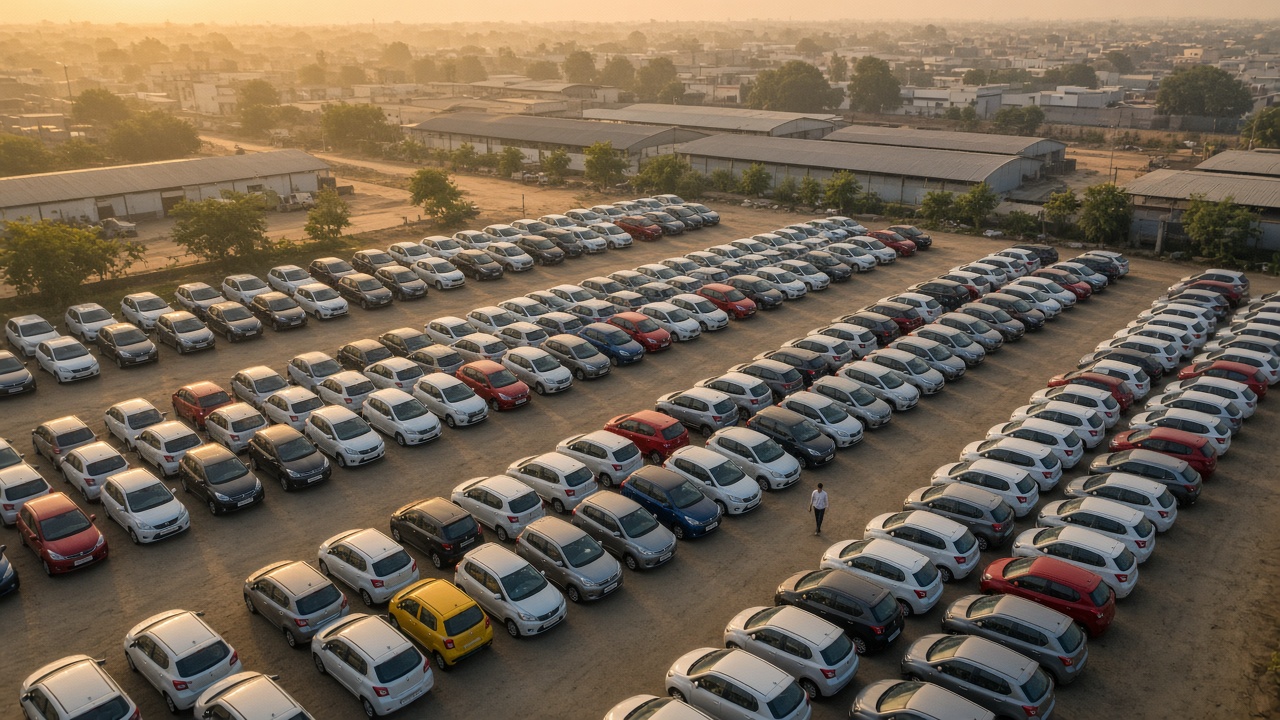
Thirty-two percent. That was the headline number for September passenger vehicle retail, and it was repeated across a lot of pages without the warning that FADA put in the title of its own press release. The dealers' body asked everyone to read the 31.82 percent "with discipline". Fair enough, so let us do that.
Retail came in at 4,27,213 cars, against 3,23,391 in September 2025. The reason last year's figure is so low is simple. Buyers sat on their hands in the weeks before GST 2.0 came into effect on 22 September 2025, waiting for the price cuts. This September is being compared with a month in which a great many buyers were waiting. FADA's president Sai Giridhar called it the most base-distorted print of the year, and said the truer run-rate is the roughly 17 percent growth of the first five months of this financial year.
None of that makes September a bad month. September was the best ever, and 6.17 percent better than August. Demand is good. Just not 32 percent good.
Who actually won
Maruti sold 1,69,132 cars and held 39.59 percent of the market, which is a little below the 40.21 percent it had a year ago. It still outsold the next three carmakers put together. Mahindra at 57,343 edged past Tata at 57,254, a gap of 89 cars, which is the sort of margin that makes both companies check their numbers twice.
Kia grew the fastest among the big names, up 45.91 percent, and Autocar India credits the new Seltos for it. Honda grew 42.51 percent, but that is on 5,283 cars. Maruti's 30 percent is on a base more than thirty times larger. They are not the same kind of percentage and it is slightly unfair to put them in one column.
Prices are the real worry
The real worry in the dealer notes is not volume, it is price. FADA wrote that affordability has been the single engine of this cycle, and that further price increases eating into it are the foremost risk for the quarter ahead. They have a point, because the hikes have been relentless. Maruti has announced three increases this year, up to ₹30,000 each in June and August and up to ₹20,000 on select models in September. Hyundai has done three. Tata's passenger vehicle arm has done three, the latest of up to ₹25,000 in September. Mahindra raised prices by up to 2.5 percent in April and an average of 2.7 percent on SUVs in July. Skoda added up to 1.2 percent from 1 October, capped at ₹20,000.
The carmakers' line is that cost pressure from the West Asia war, a weaker rupee and commodity prices leaves them little choice. Tata Motors PV chief Shailesh Chandra said only a limited part of the cost increase has been passed on so far, and that industry-wide hikes since the GST cuts are still below 5 percent. I do not doubt it. Five percent on a ₹10 lakh car is ₹50,000 though, and that is real money. Telling a buyer that part of his GST benefit has moved over to the manufacturer's margin is hard, even when that is roughly what happened.
Then there is the loan. Mint reported that dealers think higher auto-loan rates could hurt festive demand more than the price hikes, as the RBI tightens policy. Most of us buy cars on EMI, so a rate change reaches the showroom faster than any press release.
Zoom out to the quarter and the SIAM picture is the same, only calmer. Domestic passenger vehicle sales for July to September came to 13,60,687 units, up 30.7 percent, with utility vehicles making up about 68 percent of them. SIAM itself expects growth in the second half of the year to be positive but slower, since the comparison gets tougher, and it lists inflation and the interest rate it might bring as risks. When the industry body and the dealers' body both say "moderate", I believe them.
Stock is the number I would watch
Passenger vehicle inventory at dealers is around 43 to 45 days, up from 38 to 40 days in August. A year ago at this point it was about 60 days, so it is better than last year. That is still nearly twice what FADA would like, which is 21 to 25 days. Giridhar told Business Standard that 45 days is healthy ahead of the festive peak, when showrooms can do one and a half to two times their normal monthly retail. The plan is to bring it down to about 30 days by December.
SIAM's September dispatches to dealers were 4,54,574 cars, against retail of 4,27,213. The two are counted differently, so I would not subtract one from the other with a straight face. The direction, though, matches what dealers say about stocking up for the festivals.
Do not panic in November
FADA's Saharsh Damani has already warned that October may "optically look a bit softer and November a bit stronger" without any real change in underlying demand. Last October was the first full month of post-GST pent-up demand, and this year Diwali has moved to November. So there will be a headline sometime in early November saying growth has slowed, and another one a month later saying it has bounced back. Neither will mean much.
If you want to know how the market is really doing, ignore the year-on-year figure for a quarter. Look at how many days of stock dealers are carrying and how large the discounts have become. Those two numbers are harder to dress up.