Hyundai's press note on the Bayon runs long and never states a price. What it does state, in the very first bullets, is that this SUV has a generative AI voice assistant. Hyundai unveiled the Bayon on 12 October, bookings are open at ₹11,000, and the prices arrive on 26 October. For two weeks, then, the only thing a buyer can judge is the pitch, and the pitch is a chatbot in the dashboard.
What Hyundai is actually promising
Hyundai calls it the first generative AI voice assistant in any of its cars in India. The answers come from Perplexity and the voice processing from SoundHound AI. The examples in the press note are telling. You could ask it to plan a travel itinerary for a road trip, suggest hotels at your destination, recommend restaurants, list the top five shopping destinations nearby, or tell you the sports score. The idea, as Hyundai puts it, is that you speak normally instead of memorising fixed commands.
Sitting beside that is a more modest feature that I think matters more. The car carries over 500 embedded voice commands in English, Hindi, Hinglish, Tamil, Bengali and Telugu, and Hyundai says they work without an internet connection. The company describes them as covering "several in-car functions" and does not list which ones. That vagueness is worth a question at the showroom, because the chatty assistant is only as good as your mobile signal. Anyone who has driven the stretch between two district towns knows how often that signal goes missing. My bet, and it is only a bet, is that the offline commands are what owners will actually use on a Tuesday morning.
There is another gap. The press note does not say if the AI assistant or the Bluelink features, which Hyundai counts at more than 70, will need a paid subscription after some initial period. I would not assume an answer either way until Hyundai gives one.
The cabin around the assistant
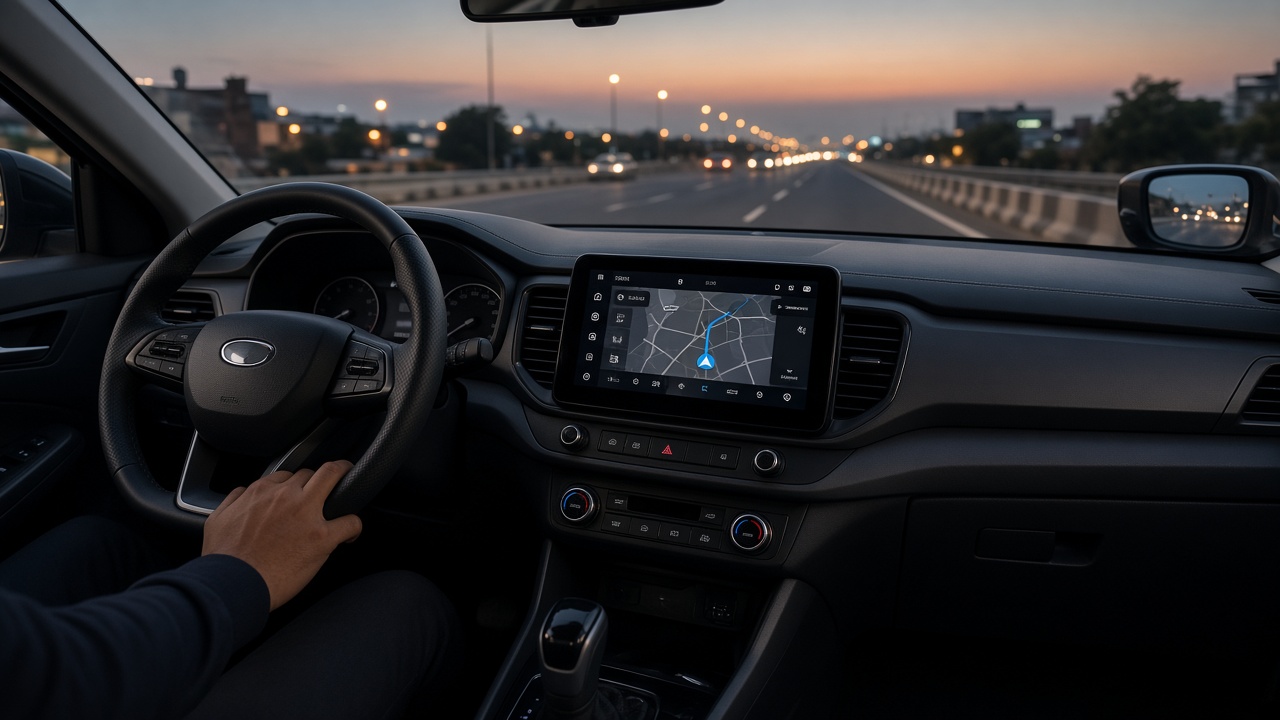
Two 12.3-inch screens sit on a curved panel, one for the instruments and one for infotainment. Hyundai also says the car has up to 19 controllers that can take over-the-air updates, which it claims will cut down on dealer visits. Autocar India reports that the interior looks very much like the Brazil-spec i20, and it points out, with some relief, that there are physical shortcut buttons below the touchscreen, more on the steering wheel and haptic ones on the centre console.
I side with that relief. A voice assistant is a fine thing to have, but if you can only change the cabin temperature by talking to a screen, nobody is better off. The physical buttons are the quiet good news in this cabin, and they say more about how Hyundai expects people to drive than any of the AI talk.
The engine is the familiar one
Under the bonnet is the 1.5-litre naturally aspirated petrol that makes 115 PS and 144 Nm, with a six-speed manual or an IVT automatic. Autocar India says this is the same engine that powers the Creta. CarWale adds that there is no diesel and no turbo-petrol, and Autocar expects a CNG version later, though Hyundai has not confirmed it. Hyundai's press note gives no mileage figure either.
That is an odd thing to leave out in the same week that Mahindra launched the XUV 3XO ZNG at ₹9.99 lakh with a certified 24.7 km/kg, and Toyota launched the new Glanza from ₹6.99 lakh. Both of those launches lead with running costs or entry price. The Bayon leads with software. Fine as a strategy, but a family buying their first midsize SUV tends to ask about the petrol bill before the Perplexity integration.
Where the price will decide everything
Nobody outside Hyundai knows the price yet. Autocar India and NDTV both expect something between ₹9 lakh and ₹14 lakh ex-showroom, while CarWale's estimate runs from ₹9.79 lakh to ₹15.49 lakh. Treat all of these as guesses. For context, CarWale lists the Venue from ₹8.00 lakh and the Creta from ₹10.91 lakh, and Autocar India, CarWale and NDTV all place the Bayon between the two.
Autocar India says it is squarely aimed at the Maruti Victoris, while NDTV frames the Skoda Kushaq as its rival. The two outlets disagree, which tells you the Bayon sits in an awkward but interesting gap. Autocar also writes that the next-generation Creta will move higher up in Hyundai's range with a wider choice of powertrains, hybrid included. Reading those together, my guess is that Hyundai wants the Bayon to be the simpler, cheaper, more gadget-heavy option and the Creta to be the one for people who care about engines.
My own view is that this plan works only if the top variants stay sensible. If a fully loaded Bayon lands at ₹14 lakh or more, it will be priced above the Creta's starting figure, and a buyer will be asked to pay a Creta's money for a smaller car whose main novelty is a talking assistant. Some people will happily do that. Most, I suspect, will look at the Creta again.
What I would do before 26 October
If you have already paid the ₹11,000, ask the dealer for the refund terms in writing. If you have not, there is little reason to rush, since the prices are public in under ten days and deliveries are only described as starting during the festive season. When the test drive does happen, ask the salesperson to put the phone in aeroplane mode and see what the car can still do. Ask which commands work offline, ask what the connected services cost after the first period, and ask for a real-world mileage number from someone other than the brochure.
A good voice assistant would be a genuine convenience. But a car is bought on price, fuel bills and how it feels at the end of a long drive, and the Bayon has not told us the first two yet.